I still remember the frenzy back in 2020 when Riot Games dropped Valorant into the closed beta. Everyone and their cat wanted a key, and the hype was justified. Fast forward to 2026, and Valorant isn't just surviving—it’s thriving. A huge part of that staying power? You can still play it on basically anything that has a screen and a keyboard. Seriously, have you looked at the minimum requirements lately? They’re almost laughable by modern standards, but that’s the beauty of it.
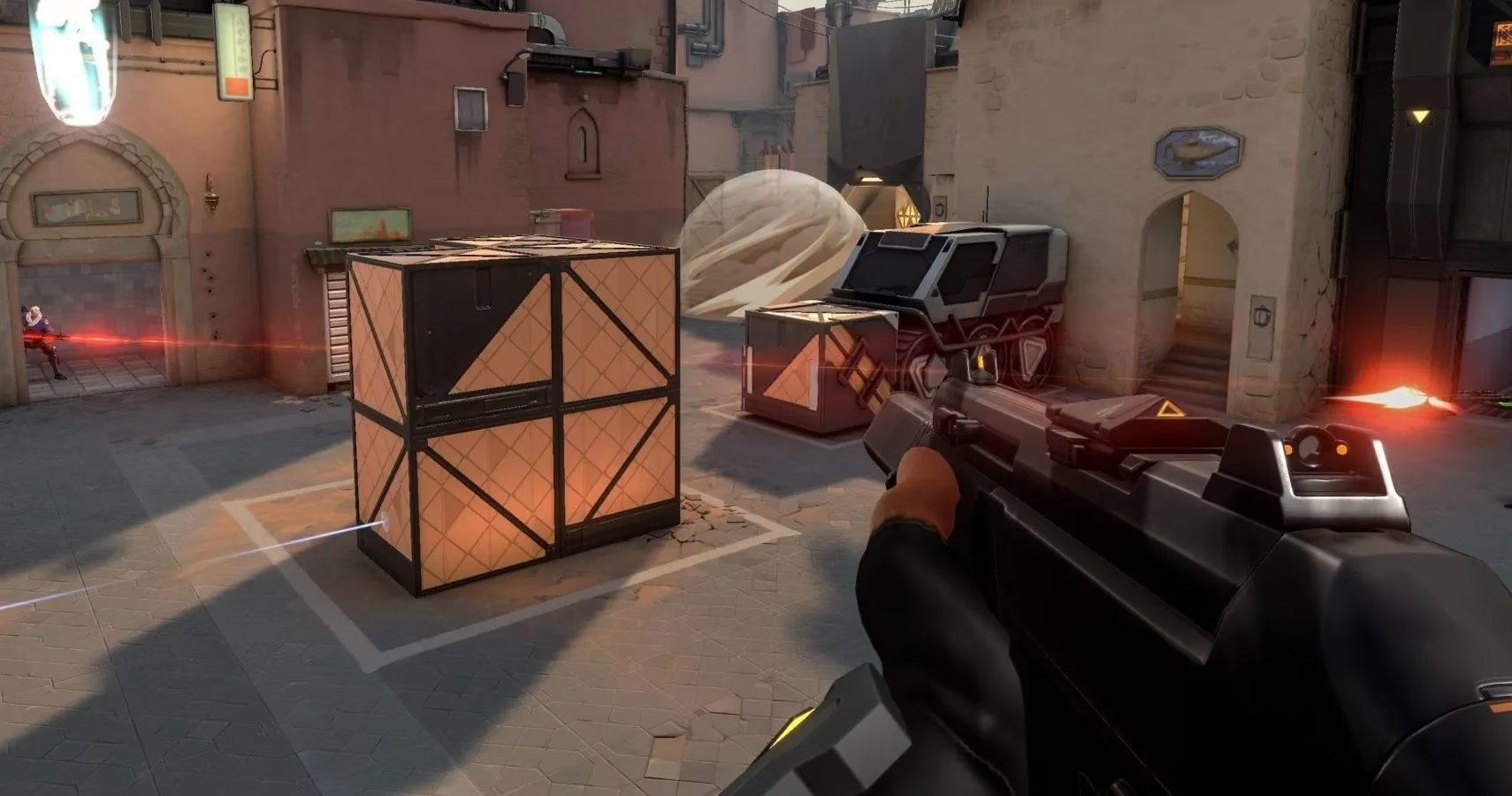
When we talk about competitive shooters, the conversation often drifts to frame rates, pixel response times, and whether you need a second mortgage for a graphics card. Valorant sidestepped all that nonsense from day one. The art style is deliberately clean, with no visual clutter that could obscure an enemy strafing around a corner. This minimalist approach isn’t just an artistic choice; it’s the secret sauce that lets the game run on integrated graphics from a decade ago. Can you imagine trying to fire up a 2024 AAA title on an Intel HD 3000? You’d get a slideshow. But Valorant? Smooth 30 FPS, baby. And let’s be honest, that’s perfectly playable if you’re just looking to have fun with friends.
Let’s put those numbers under a microscope because they really are worth celebrating. The absolute bare-minimum spec back in the day was an Intel Core 2 Duo E8400 and that trusty Intel HD 3000 integrated GPU. Those components were ancient even in 2020, and here in 2026, they’re practically museum pieces. Yet, Riot has continuously optimized the game to the point where those specs haven’t changed. If you’ve got an old office PC gathering dust, you can install Valorant, and I’d wager it’ll chug along at a steady 30 frames. Not everyone is chasing Radiant with a 540Hz monitor, right? For the rest of us, 30 FPS with a free game is a gift.
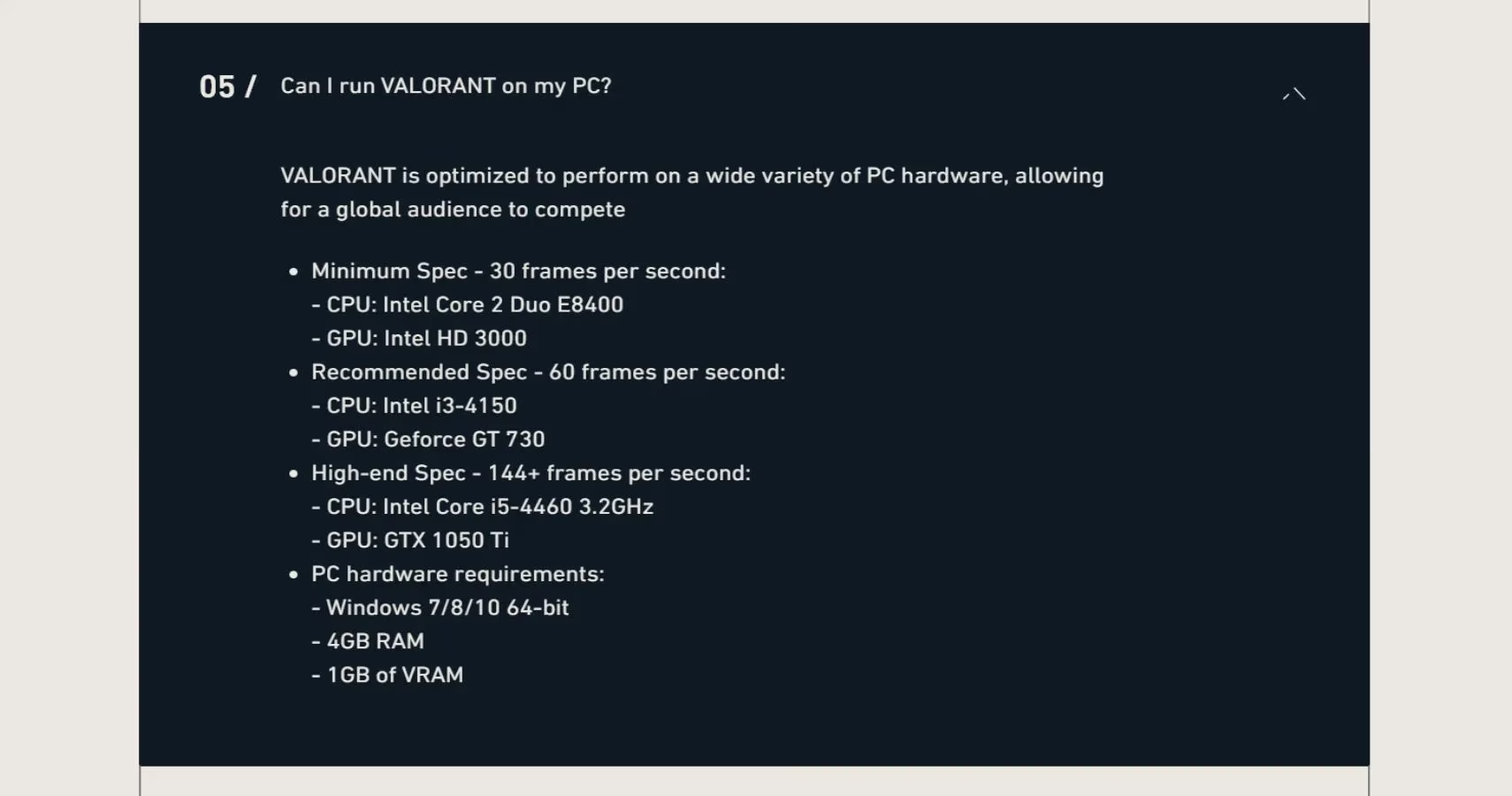
For those who wanted the sweet spot—60 FPS—the recommended specs were equally humble: an Intel i3-4150 and a GeForce GT 730. I built a budget PC around those parts in college, and it handled Valorant like a champ while barely breaking a sweat. Now in 2026, you can pick up that level of hardware for literally the price of a fancy dinner. That’s the real kicker: Valorant doesn’t demand that you keep climbing the hardware treadmill. You don’t need ray tracing, DLSS 5.0, or neural rendering cores to enjoy crisp, reactive gunplay. The game’s engine is a marvel of efficiency that still blows my mind.
Of course, the competitive crowd is always thirsty for more. High-end specs for pushing 144+ FPS were listed as an Intel Core i5-4460 and a GTX 1050 Ti. In 2026, those are considered entry-level gaming components. What does that tell you? Even the high-end requirement has aged into affordability. A teenager with a used gaming laptop from 2018 can easily hit 200 FPS in Valorant and compete at a high level. That’s a radical departure from other esports titles that seem to demand a new graphics card generation just to keep a stable frame rate after a patch.
And we haven’t even mentioned the RAM and OS requirements. Back in 2020, you needed Windows 7/8/10 64-bit, 4GB of RAM, and 1GB of VRAM. Those numbers haven’t changed either. In an era where 8GB of RAM feels like the bare minimum for opening a web browser with a dozen tabs, Valorant sips memory like a tiny hummingbird. It’s borderline magical. So many modern games suffer from what I call “menu lag”—you open the inventory screen and suddenly your GPU fans sound like a jet engine. Valorant sidesteps all that. The UI is snappy, the in-game overlay is lightweight, and you’re never penalized for having a modest setup.
Why does all this matter in 2026? Because accessibility is still the name of the game. Riot didn’t just make a shooter; they made a community hub that doesn’t discriminate based on your wallet. How many times have you tried to convince a friend to jump into a new game only to hear, “My PC can’t run it”? That conversation never happens with Valorant. The free-to-play model combined with absurdly low spec requirements means literally anyone with a Windows machine can join in. In regions where high-end hardware is a luxury, Valorant has become the default social space. That’s a powerful moat no competitor can easily cross.
Let’s also give credit to the ongoing optimization updates. The game has grown with new agents, maps, and abilities that add visual complexity, yet the performance target remains rock solid. I’ve run Valorant on a Surface Pro from 2019 during a trip, and it held 60 FPS with some settings tweaked. Try that with any other modern competitive shooter and you’ll be staring at a crash report. Riot understands that for a tactical FPS, consistency trumps graphical fidelity. A stutter at the wrong moment means a lost round, and ranked anxiety is bad enough without blaming your hardware.
Is the visual experience basic compared to some newer titles? Sure, if you’re sitting there pixel-peeping instead of clearing angles. But in practice, the clarity is a competitive advantage. Every enemy silhouette pops against the environment, smokes are defined but not over-rendered, and you’ll never lose sight of a Jett dashing through a corridor because of excessive particle effects. That’s why even players with top-tier gaming rigs often stick with low settings—they want that pristine, almost surgical visual feedback. The art direction earns its keep by serving gameplay, not the other way around.
So where do we go from here? I fully expect Valorant to maintain these incredible optimization standards through 2026 and beyond. As new hardware emerges and operating systems evolve, Riot’s commitment to the low-spec player base feels like a promise. In a world where technology marches relentlessly forward, it’s refreshing to have a game that basically says, “Your old PC is still good enough. Come play.” That’s the kind of inclusive philosophy that keeps a game alive way past the usual expiration date. If you haven’t jumped in yet, what are you waiting for? That dusty laptop in your closet just found its calling.