I still remember the first time I picked Breach back in 2020. Fast forward six years, and here I am, still locking him in when I need to shake things up. Don’t get me wrong—plenty of agents have joined the roster since then, but there’s something about this Swedish bionic arm-wielding giant that just clicks with my playstyle. He’s loud, he’s obnoxious, and honestly, he can completely ruin the enemy team’s day. If you haven’t given him a serious try lately, you might be missing out on one of the most disruptive initiators in VALORANT right now.
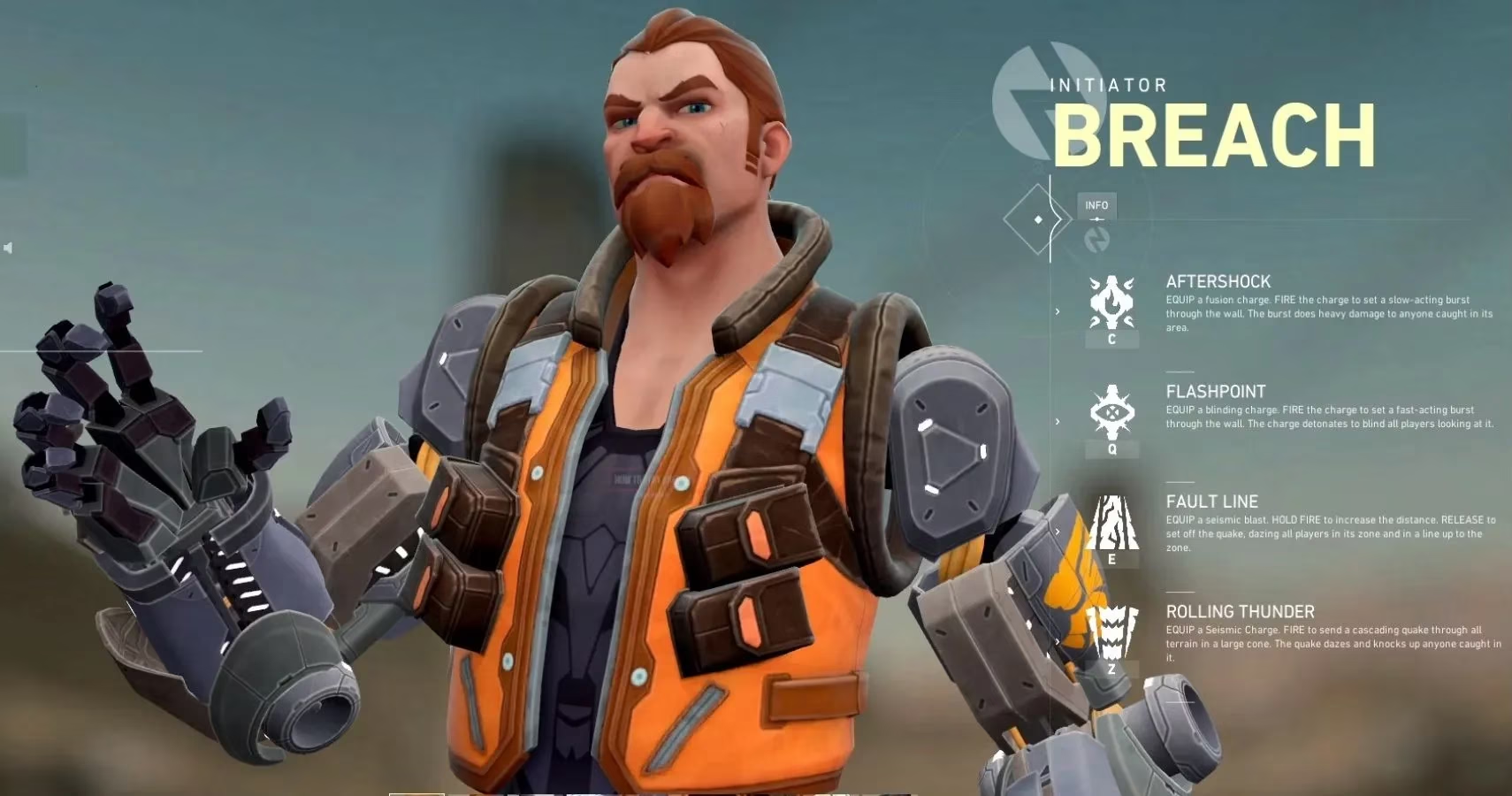
So what makes Breach so special in 2026? His kit hasn’t changed drastically over the years, but that’s part of the charm. He still revolves around four abilities built to control space and force opponents out of their comfort zone. Let me walk you through them like I’m explaining it to a buddy over a post-match coffee.
First, we have After Shock. This is the one where you place a charge on a wall, and after a brief delay, it blasts through the other side. Think of it as a “hello” from the other side—a very painful hello. The damage is chunky, and it’s perfect for clearing out corners or denying defuse attempts. I’ll admit, though, sometimes I whiff the timing. You see that red indicator, you panic, and you move out of the way. Smart opponents know this, so you’ve got to mix it up. I usually use it to cut off retreat paths rather than go for direct kills.
Next up is Flash Point, and boy, do I love this one. It works exactly like After Shock but instead of damage, it sends a blinding flash through the wall. In tight corridors and around common hiding spots, this ability is an absolute nightmare for defenders. I can’t tell you how many times I’ve flashed through a wall on Split or Haven, rushed in, and found three enemies staring at the sky. It’s consistently been one of the best tools for clearing angles without exposing yourself. And with the recent quality-of-life update last year that made the flash indicator slightly larger, hitting those multi-blinds feels more satisfying than ever.
Then there’s Fault Line, Breach’s signature ability. This seismic charge travels along the ground, and the longer you hold it, the longer the range. When it hits an opponent, they get disoriented—their vision blurs and their aim gets all wobbly. I like to call it the “free kill button” because if you land it on someone holding an angle, they’re basically a sitting duck. It’s also amazing for setting up your teammates. A well-timed Fault Line through a wall can turn a losing round into a highlight reel. Just be careful not to stun your own team. Trust me, I’ve learned that lesson the hard way.
Finally, the big bad Rolling Thunder. His ultimate sends out a massive cone-shaped seismic blast that travels forward, disorienting and knocking anyone it touches into the air briefly. It’s like Fault Line on steroids. The moment I hear that rumbling sound, I know we’re either taking a site or stopping a push dead in its tracks. The knock-up makes enemies float helplessly for a second, which is just enough time to line up those headshots. In 2026, with the intense mobility creep some duelists have seen, this ultimate remains one of the best equalizers. I’ve won countless eco rounds off a single Rolling Thunder combo.
But let’s be honest—playing Breach isn’t all sunshine and tremor-induced chaos. He can feel a bit sluggish if your team isn’t coordinating well. His abilities go through walls, so you need good map knowledge and a sense of where enemies might be hiding. There’s nothing worse than unleashing your ultimate into an empty room while your teammates are dying on the other side of the map. Also, his lack of a traditional movement ability means you have to commit to fights. I’ve had my fair share of moments where I’m stuck reloading while a Jett dashes three times around me.
Still, the highs far outweigh the lows. Over the years, I’ve found a rhythm with Breach that feels almost meditative. On defense, I’ll hug a wall, listen to footsteps, and charge up a Fault Line just as they’re about to peek. On attack, I’ll pair up with a Raze or a Phoenix and just pummel a site entrance with flashes and tremors until the enemy team has to fall back. It’s a playstyle that rewards patience and clever angles over raw aim, and that’s why I keep coming back to him.
The VALORANT community has also started to appreciate Breach more over the last couple of years. I’ve noticed in pro play and ranked that he’s no longer seen as a niche pick. In fact, with the recent map pool rotations favoring tighter chokepoints, his wall-piercing utility has become invaluable. I wouldn’t be surprised if we see even more Breach mains pop up as new players discover how satisfying it is to cause mayhem from behind solid cover.
If you’re thinking about adding Breach to your agent rotation, here’s my simple advice: practice on maps with lots of thin walls—Bind and Pearl are personal favorites. Learn the common plant spots and retake routes so you can pre-aim your After Shock and Fault Line. And for the love of all that is holy, communicate with your team. A Breach who calls out his flashes and stuns is ten times more effective than one who just presses buttons and hopes for the best.
At the end of the day, Breach isn’t just an agent; he’s a statement. When I lock him in, I’m telling the enemy team that their carefully set up defenses are about to come crashing down. There’s a certain joy in hearing the sound of Rolling Thunder echo through the map and watching the kill feed light up seconds later. So yeah, give the big guy a shot. You might just find yourself causing some well-deserved chaos.