Alright, gather 'round, fellow agents! Let me tell you about the time Riot dropped a frozen bombshell on us back in the day and how its chilly legacy still sends shivers down our spines in 2026. I remember logging in for the Episode I, Act III update, expecting maybe a new skin or a balance tweak, and BAM—I was staring at a loading screen for a place called Icebox. My first thought? "Great, another map to learn the hard way by getting headshot from a snowbank." Little did I know, this frosty battleground would become a staple of the competitive scene, evolving far beyond its initial 2020 debut.
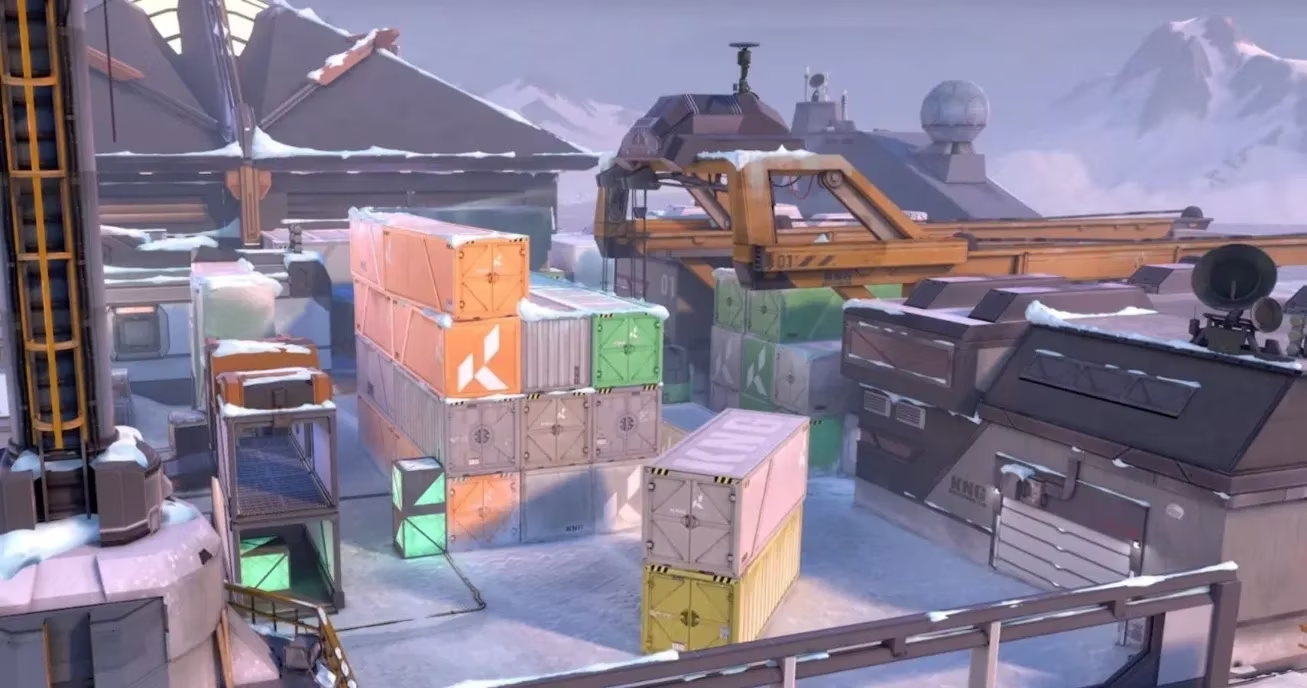
❄️ The Frosty Foundation: A Map Born from a Glacier
So, what's the deal with Icebox? Picture this: a massive cargo ship, seemingly abandoned next to a towering, ominous wall of ice. It's like someone decided to have a firefight in the middle of a global shipping crisis at the North Pole. The aesthetic was a total game-changer back then. Before Icebox, we were running around in sunny, clear-skied locales like Bind and Haven. Suddenly, we're dodging bullets while our breath fogs up our scopes! The tundra theme wasn't just for looks; it introduced a whole new environmental dynamic. Those large shipping containers weren't just decoration—they created a labyrinth of choke points and unexpected angles that forced us to rethink our entire strategy. I can't tell you how many times I've been ambushed from inside a crate I swore was just part of the scenery!
🚠 The Zipline Revolution: Verticality Gets an Upgrade
Now, let's talk about the real star of the show: the ziplines. Oh, the ziplines! When I first saw them, I thought, "Neat, like Split but... colder." But boy, was I wrong. These weren't just for show. They added a layer of vertical mobility and strategic unpredictability that was unheard of at the time.
-
For Defenders: Suddenly, rotating between sites wasn't just a sprint; it could be a high-speed zipline dash across the map. Trying to retake the B Site? Hop on the zipper and whoosh—you're there before the attackers can even plant the Spike.
-
For Attackers: Executing a site rush took on a whole new meaning. Imagine five agents zipping onto a site from an unexpected high angle. The element of surprise was palpable, and the chaos was glorious.
This mechanic fundamentally altered the competitive meta. Teams had to develop entirely new protocols for map control and information gathering. In today's 2026 meta, mastering Icebox's ziplines is as crucial as knowing your lineups for Sova's dart or Viper's wall.
🗺️ Icebox's Place in the VALORANT Pantheon
As the fifth map and the first post-launch addition, Icebox carried a lot of weight. It proved Riot was committed to expanding the tactical shooter's landscape beyond the launch quartet. Let's break down how it stacked up against its siblings back then and how it's evolved:
| Map Name | Key Feature (Then) | Legacy & Evolution (Now in 2026) |
|---|---|---|
| Bind | Teleporters for instant flanks | Still a duelist's paradise for aggressive plays. |
| Haven | Three bomb sites for maximum chaos | The ultimate test of adaptive defense and map splits. |
| Split | Vertical ropes and tight mid | A classic that taught us the importance of mid control. |
| Ascent | Mechanical doors for map control | The blueprint for balanced, methodical play. |
| Icebox | Horizontal & Vertical Ziplines | Pioneered multi-layered, fast-paced rotations. |
Icebox's winter theme was its signature, but its true legacy is its structural innovation. It taught us to look up, down, and all around. Fast forward to 2026, and while we have maps with even crazier gimmicks (looking at you, Lotus with your rotating doors), Icebox remains the gold standard for integrating movement tech into core gameplay.
⚙️ The Act III Package: More Than Just a Map
The Icebox update wasn't a solo act. It came bundled with a crucial change to competitive integrity that still shapes ranked play today. Riot tightened the rank disparity rules for party queues. Back then, you could queue with pals within six ranks. Act III slammed that window shut to just three ranks. At the time, my five-stack had a minor meltdown. But in hindsight? It was a genius move for matchmaking fairness. It prevented high-ranked players from boosting their lower-ranked friends into lobbies they had no business being in, preserving the skill-based essence of the game. This philosophy has only been refined over the years, leading to the robust and (mostly) balanced ranked system we enjoy in 2026.
🏔️ The Icy Legacy in 2026
So, where does Icebox stand now, several years and many acts later? It's no longer the "new map"; it's a venerable veteran. Its initial learning curve—figuring out the zipline timings, the sneaky cubby holes in the ship, the long sightlines down Tube—has been well-documented. Pro teams have entire playbooks dedicated to its nuances. For us regular players, it's a map that constantly demands respect. One moment you're holding an angle, the next you're getting picked off by an Operator from a zipline you forgot to check.
Its winter theme, once novel, now feels like a classic part of VALORANT's diverse world. It serves as a reminder of the game's commitment to thematic variety and mechanical experimentation. Every time I queue into Icebox, I'm reminded of that October 2020 surprise and how a simple concept—a frozen shipyard—could fundamentally expand how we think about space, movement, and tactics in this game we love. It's more than just a map; it's a chilly, chaotic, and utterly essential chapter in VALORANT's ongoing history. Now, if you'll excuse me, I have a zipline to catch and a site to defend. Wish me luck—I'll need it against these 2026 radiant demons!