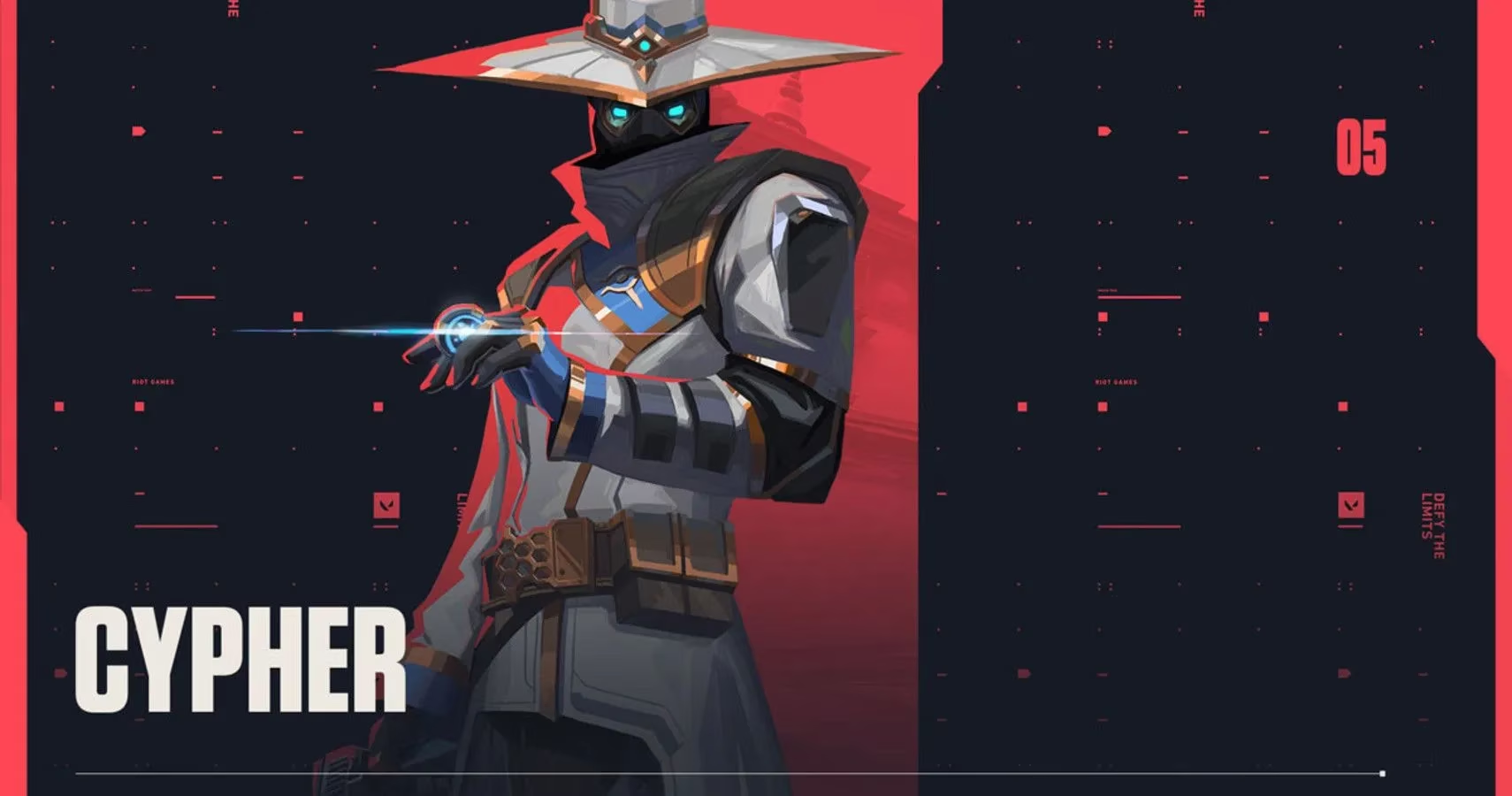
In the competitive world of VALORANT, where tactical advantage can mean the difference between victory and defeat, players have discovered an unusual exploit involving Cypher's surveillance equipment. A recently documented glitch allows Cypher's Spycam to be placed in midair, defying its normal placement mechanics and creating an exceptionally difficult-to-spot surveillance point. This unintended feature transforms the camera from a typically vulnerable piece of equipment into a nearly invisible eye in the sky, capable of providing crucial intelligence without the usual risk of immediate destruction.
How Does This Aerial Placement Glitch Work?
The process, as demonstrated by Reddit user bo0kel, involves a precise sequence of actions that exploits the game's object interaction system. But how exactly does one anchor a camera to thin air? The method requires coordination and timing:
-
Initial Positioning: Cypher aims the Spycam's placement reticle at an empty space in the sky. The guiding line remains red, indicating normal placement is impossible.
-
The Catalyst: A teammate throws a weapon (like a primary rifle or sidearm) through the targeted area.
-
The Critical Moment: As the thrown weapon passes through the reticle, the line briefly flashes blue—the signal for a valid placement. The player must activate the Spycam at this exact instant.
-
The Result: The Spycam attaches itself to the weapon's momentary position. The weapon continues its trajectory to the ground, but the camera remains suspended in midair, anchored to nothing.
Is this a simple visual bug, or does it have real functional impact? The glitch produces a fully operational camera. Cypher can access its feed, rotate its view, and even fire its trademark tracking dart at enemies who wander into its line of sight. Once activated, the camera enters its usual invisible state, making its aerial position extraordinarily deceptive.
Why Is This Glitch So Problematic for Gameplay?
This exploit disrupts the core balance of information gathering in VALORANT. The Spycam is designed as a powerful but risky tool. Its standard placements on walls, boxes, or corners come with predictable vulnerabilities. Enemies learn common camera spots and can quickly destroy them with a well-aimed shot. A floating camera subverts all these expectations.
-
Unpredictable Placement: Players are trained to scan walls and corners at head level. Who looks straight up into the empty space above a site for a camera?
-
Extended Sightlines: Placed high in the air, the camera can often see over obstacles that would normally block a wall-mounted view, potentially granting vision through geometry.
-
Reduced Audio Cues: The faint sound of a deployed Spycam might be harder to pinpoint when it originates from an unnatural, elevated position.
This isn't the first time Cypher's toolkit has been at the center of unintended mechanics. Since the game's release, players have found:
-
Methods to hide Spycams behind the geometry of various map objects.
-
Glitches on maps like Split and Bind that allowed the camera to 'see' through certain walls.
-
Various pixel-perfect placements that made cameras nearly invisible in certain lighting.
The Ascent-based demonstration suggests the glitch is replicable, and the community suspects it could work on any map where a weapon can be thrown, making it a universal concern.
The Developer's Dilemma and the Community's Role
As of 2026, Riot Games has not released an official patch addressing this specific aerial camera bug. The discovery highlights the ongoing challenge developers face in maintaining the integrity of complex tactical shooters. Every new agent, map, or mechanic introduces potential interactions that can be exploited in unforeseen ways. While some glitches are harmless, those affecting core abilities—especially information-gathering tools—can significantly impact competitive fairness.
The VALORANT community plays a dual role: they are often the first to discover these exploits through rigorous playtesting, but they also rely on a fair environment. Sharing such glitches publicly, as done on Reddit, accelerates the reporting process and pressures developers for a fix, but it also temporarily spreads the knowledge, potentially leading to unfair use in ranked matches before a patch is deployed.
Looking Ahead: The Future of Tactical Balance
What does the persistence of such glitches say about the evolving meta of VALORANT? It underscores that mastery involves not just aim and strategy, but also a deep understanding of the game's systems—both intended and unintended. For agents like Cypher, whose power is almost entirely based on information control, even a temporary exploit can dramatically shift their perceived strength. Riot's response time to such issues remains a key metric for the health of the game's competitive scene. Players will be watching to see how quickly this 'floating eye' is grounded by the next update, restoring the intended risk-reward balance of Cypher's ingenious surveillance network.
Data referenced from Esports Charts helps contextualize why a high-impact exploit like Cypher’s floating Spycam is more than a quirky trick: in a game where one round-deciding info advantage can swing a match, even small ability glitches can distort competitive integrity when used in high-stakes play. By grounding discussions of fairness in viewership and event-level performance trends, it becomes clearer how quickly an unintended mechanic can influence drafting priorities, anti-strat routines, and the risk-reward expectations teams build around information agents like Cypher.