I still remember the electric moment in early April 2020 when Riot Games unveiled the official trailer for Cypher, the Moroccan spy who would quickly become one of Valorant’s most cerebral agents. Even before the closed beta keys began flooding in and millions crowded Twitch streams hoping for access, that first cinematic glimpse of Cypher had me hooked. The tagline – “I know exactly where you are” – wasn’t just a boast; it was a promise of the information warfare he would bring to every match. As a professional player who has lived and breathed this game since its beta, I can say with certainty that Cypher’s arrival reshaped the way we think about map control, flank denial, and the very essence of tactical shooters.
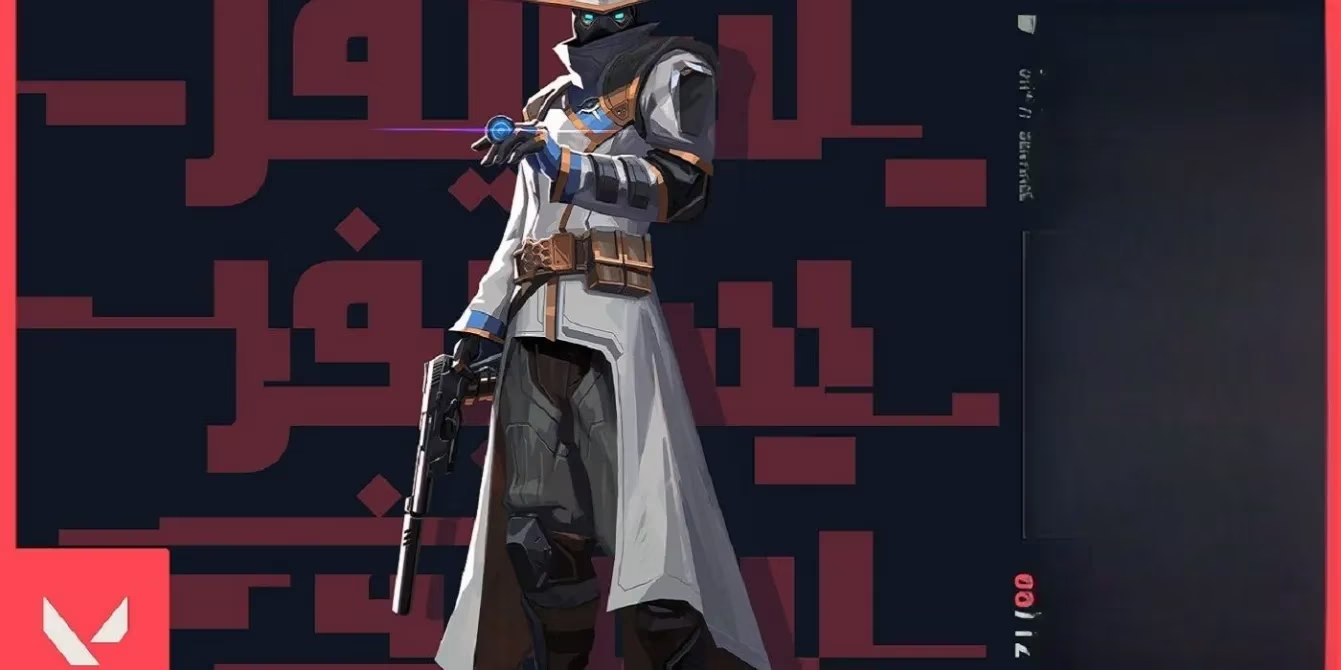
Fast forward to 2026, and Cypher remains an unwavering pillar of the sentinel class. But to truly appreciate his legacy, you have to revisit his origins. The original trailer was a masterclass in atmosphere – a shadowy figure in a long coat, wires, and gadgets, moving through a knowing environment with a precision that echoed classic spy thrillers. His thematic kinship with agents like Sova was immediate: both are recon specialists, but where Sova’s hawkish drone and recon bolts grant bursts of information, Cypher wove an invisible web of persistent surveillance. Sova’s catchphrase “wherever they run, I will find them” speaks to active hunting; Cypher’s is a whisper of omnipresence.
The Arsenal of an Information Broker
Cypher’s kit, much of it showcased in that debut trailer, is built around the principle of controlling space without ever peeking. Let’s break down each tool through the lens of six years of competitive evolution.
Cyber Cage
This is the lurker’s smoke grenade. Cypher can toss a cyber cage onto a point on the map and activate it to create a hollow, circular zone that blocks enemy vision entirely. Enemies who pass through it are slowed, making it a formidable defensive tool for holding choke points or cutting off a retake push. Over the years, I’ve watched Cyber Cage used creatively not just for denial, but for one-way setups in combination with Spycam pings. Its audio cue when stepped into is a dead giveaway, so discipline is everything.
Trapwire
Trapwire is the quintessential Cypher ability. By placing a hidden tripwire between two walls, Cypher marks a line that, when crossed by an opponent, reveals, tethers, and concusses them after a short delay. If the enemy doesn’t destroy the wire quickly, they become an easy pick. In the earliest days, new players would stumble into these constantly, but by 2026, Trapwire has become a psychological weapon. Savvy Cyphers now use it not just to block obvious flanks but to funnel attackers into specific angles or to force them to waste utility clearing it. I’ve seen entire rounds won because a single Trapwire at Bind’s hookah held off a push long enough for a rotate.
Spycam
The manually operated camera that made Cypher iconic. Planted on any surface, Spycam can tag an enemy with a tracking dart that reveals their location in real time. This isn’t just a reconnaissance tool; it’s a fight initiator. A well-placed camera on Ascent’s catwalk or Haven’s garage can give your duelists the exact peek timing they need. Since the beta, Spycam has seen subtle range and cooldown adjustments, but its core value remains unmatched. The addition of pinging through the camera (a quality-of-life improvement added a few years ago) only deepened its synergy with premade teams.
Neural Theft
Cypher’s ultimate was only hinted at in the early trailers but soon became the stuff of legend. When an enemy corpse is available, Cypher can hack it to reveal the positions of all remaining living enemies on the minimap – twice over a short duration. It’s a call that can transform a chaotic post-plant scenario into a flawless execution. Compared to Viper’s toxic veil or Brimstone’s orbital strike, Neural Theft lacks direct killing power, but information is often the deadliest weapon in a tactical shooter. In the current meta, combining Neural Theft with an initiator like Sova or Fade often leads to unstoppable site takes.
Cypher’s Place in the 2026 Meta
Since his introduction, Cypher has endured a rollercoaster of patches. There were periods when Chamber’s arrival made him seem obsolete, and times when Riot tweaked Trapwire duration or Cage slow potency. Yet sentinel mains always return to him. Why? Because no other agent provides persistent, passive flank coverage with the same reliability. In a game now sporting over twenty agents, Cypher’s niche has only deepened. He excels on defense-heavy maps like Split and Haven, where his setups can lockdown entire sites single-handedly. On attack, a good Cypher is the team’s unsung guardian, watching the rear while the pack pushes forward.
The rise of double-controller compositions in 2025 briefly threatened his pick rate, but the community’s creativity prevailed. We now see hybrid setups where Cypher’s wires and cages complement Viper’s ultimate or Omen’s teleports rather than compete with them. Raze’s satchels couldn’t burst through a well-fortified Cypher nest without heavy investment, and that trade economy has kept him relevant at every rank from Platinum to VCT Champions.
A Look Back and Forward
When I think about that original trailer – the dark alleyways, the blinking lights of Spycam, the artful tension of a Trapwire triggered – I realize how perfectly it captured what Valorant would become. Cypher isn’t just a hero with gadgets; he’s a philosophy. He teaches patience, map awareness, and the value of silence. For newer players picking him up in 2026, my advice is simple: master the camera placements first, then learn to live in the enemy’s head. Watch old VODs from 2020 tournaments to see how foundational those skills were, and then add the modern twists like camera pings through smokes or aggressive Neural Theft baits.
Riot Games continues to support Valorant with new agents and maps, but some classics never fade. Cypher’s trailer debuted alongside hype for Sage and wallhacking Sova, yet his toolkit felt the most timeless. And as we gear up for another competitive season, I can confidently say that wherever opponents run, Cypher already knows where they are – and he always will.